· StartMeUp AI · 10 min read
External Developer Standards for Agentic Software Development in 2026
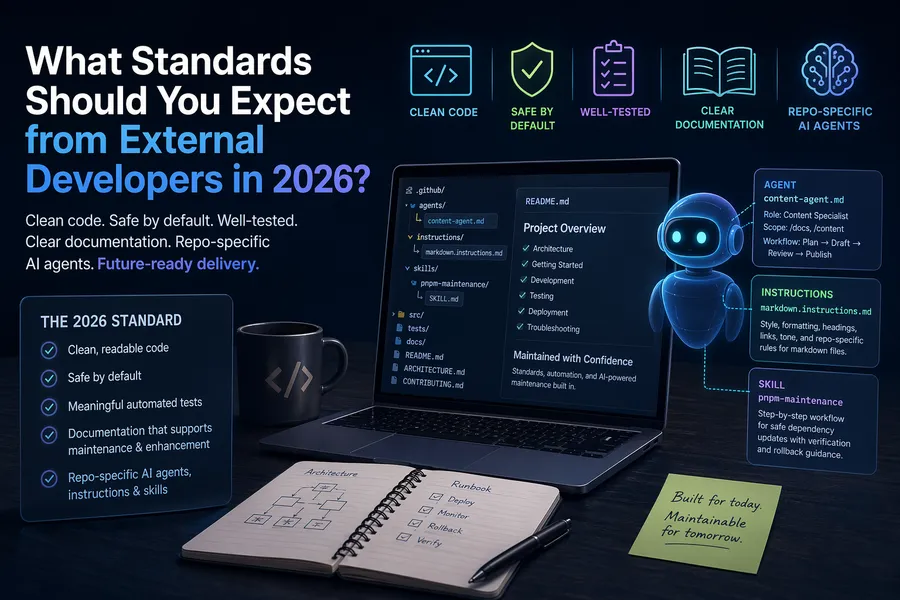
In 2026, the standard for hiring external developers is no longer just working software. In an agentic software development model, the baseline is a maintainable codebase: clean code, secure defaults, meaningful automated tests, living documentation, and a repository delivered with repo-specific AI agents, scoped instructions, and reusable skills. Together, these make future changes faster, safer, and far less dependent on the original vendor.
Introduction
If you are hiring an external developer or a dev shop in 2026, you should expect far more than a handoff call and a GitHub repository that “works on their machine.”
That may have been acceptable in 2024. It is no longer good enough.
Today, the standard should be a codebase your team can understand, operate, extend, and improve without asking the original builders to approve every small change. Modern AI software development is not just about shipping features. It is about shipping software with the maintenance system already built into the repository.
This matters for startups and established companies alike. Startups cannot afford to rebuild on messy foundations, and larger companies cannot afford vendor lock-in disguised as complexity.
What AI Software Development Means in 2026
AI software development in 2026 is the practice of building production software where AI tools, human engineers, and the repository itself actively cooperate to deliver and maintain the system. It is not simply “AI wrote the code.” It is a delivery model where:
Agentic development is a form of AI software development where human engineers, AI coding agents, and the repository operate together under shared rules. Agentic coding is not code generation in isolation. It is a controlled, human-in-the-loop coding model in which AI can propose, review, and maintain changes while the codebase carries the instructions and guardrails that keep quality consistent.
- Engineers design the architecture and set the quality bar
- AI assistants accelerate implementation, review, and maintenance
- The repository carries its own instructions, agents, and skills so every future contributor — human or AI — follows the same standards across agentic workflows
This is a meaningful shift. The repository is no longer just source code. It is a working environment that teaches future contributors how to operate safely inside it.
Why Software Delivery in 2026 Is Different from 2024
The biggest shift is not just better AI coding tools. It is that strong engineering standards can now be encoded directly into the repository.
In 2024, many teams still accepted delivery packages that looked like this:
- Source code with uneven style and weak consistency
- Limited or missing tests
- A README that explained setup, but not maintenance
- Tribal knowledge living only in the heads of the original developers
- No structured way for future engineers or AI tools to work safely inside the codebase
In 2026, that delivery model is outdated. A serious external team should leave behind a repository that is easier to maintain because the standards are documented, automated, and reusable.
| Area | Weak 2024 Handoff | Strong 2026 AI Software Delivery |
|---|---|---|
| Code quality | It works, but style and structure vary | Clean, consistent, readable code with clear patterns |
| Safety | Security is assumed, not demonstrated | Secure defaults, dependency hygiene, and safer workflows |
| Testing | A few happy-path checks | Meaningful automated tests for core behavior and regressions |
| Documentation | Basic setup notes | Runbooks, architecture notes, troubleshooting, and enhancement guidance |
| Maintenance | Depends on the original vendor | Repo-specific AI agents, instructions, and skills support future work |
The Non-Negotiable Baseline
Even before we get to AI agents and maintenance acceleration, there are fundamentals every client should expect.
Clean, readable code
Clean code does not mean “clever” code. It means code that another competent engineer can follow without reverse-engineering the author’s thought process for hours.
You should expect:
- Consistent naming
- Clear file structure
- Predictable patterns across the repo
- Small, focused modules instead of giant files full of mixed responsibilities
- Minimal technical debt shipped as “good enough”
If a team delivers code that only they can understand, they have not delivered a product. They have delivered dependency.
Safe by default
External developers should not be praised for caring about safety. That is baseline professional work.
You should expect:
- Secure authentication and authorization patterns where needed
- Reasonable handling of secrets and environment variables
- Dependency awareness and update discipline
- Safe deployment and CI workflows
- Basic consideration for failure states, misuse, and data exposure
Safe software is not only about preventing catastrophic breaches. It is also about reducing avoidable operational risk.
Well-tested software
“We tested it manually” is not a credible standard for production software in 2026.
You should expect automated tests that protect the most important paths in the product. That does not mean chasing vanity coverage numbers. It means covering the logic and workflows that matter.
Good testing usually includes:
- Unit tests for important logic
- Integration tests for real flows between components or services
- End-to-end checks for critical user journeys where appropriate
- A repeatable way to run tests in CI before code reaches production
The right question is not “Do you have tests?” The right question is “What kinds of failures would your tests catch before users do?”
Documentation that supports maintenance and enhancement
Documentation should not stop at installation.
You should expect documentation that helps your team:
- Understand the architecture
- Run the project locally
- Deploy it safely
- Troubleshoot common issues
- Extend the system without breaking its standards
That can include README files, environment setup guides, architecture notes, API documentation, testing guidance, and operational runbooks.
In other words, documentation should help the next team maintain and enhance the system, not just admire that it exists.
The New 2026 Standard: Ship the Repo with Custom AI Agents
This is the part many companies still miss.
In 2026, a strong external team should not just hand over source code. They should hand over a repository that already teaches AI tools how to work inside it safely.
That means adding repo-specific agent definitions, scoped instructions, and reusable skills so future maintenance is dramatically easier.
In practice, that can look like this:
.github/
  agents/
    content-agent.md
  instructions/
    markdown.instructions.md
  skills/
    pnpm-maintenance/
      SKILL.md
These are not gimmicks. They are part of the maintenance layer.
They are what turn a codebase into a system that can support agentic workflows instead of depending on ad hoc prompts and memory.
Agents define specialized roles
An agent file such as .github/agents/content-agent.md gives an AI coding assistant a clear role, domain boundaries, and workflow expectations.
That means future content or copy changes are not handled by a generic assistant guessing its way through your brand and repo. They are handled by an assistant that has been shaped for your project.
Instructions define standards by file type or path
Instruction files such as .github/instructions/markdown.instructions.md tell tools what rules apply to specific content.
Instead of hoping every future contributor remembers formatting conventions, documentation rules, or repo-specific expectations, those standards live in the codebase itself.
Skills turn repeated work into reusable procedures
A skill file such as .github/skills/pnpm-maintenance/SKILL.md captures a tested workflow for a recurring job.
That is powerful because maintenance work is rarely just “update the package” or “fix the docs.” Good maintenance depends on sequence, verification, and project context. Skills make that repeatable.
This is a major difference between building software in 2024 and practicing AI software development in 2026. In 2024, clients often received code. In 2026, they should receive code plus the operating knowledge that helps humans and AI maintain it responsibly.
What You Should Ask for Before Accepting Delivery
If you are evaluating an external team, use this as a practical acceptance checklist.
- Ask for a walkthrough of the testing strategy, not just a claim that the software was tested.
- Ask what documentation exists for setup, deployment, architecture, troubleshooting, and future enhancements.
- Ask how security and dependency maintenance are handled after launch.
- Ask whether the repository includes repo-specific AI agents, instructions, and skills.
- Ask whether the project can be maintained effectively by a new engineer who did not build it.
- Ask for the repo to be delivered directly into your GitHub organization, not trapped in a vendor-controlled environment.
- Ask what parts of the system are standardized versus what still depends on senior tribal knowledge.
If the answers are vague, the handoff is probably weak.
Red Flags That Still Show Up Too Often
Some warning signs are still common, even now.
- The repo has little to no automated testing
- The documentation explains setup but not maintenance
- Only one or two developers seem to understand the structure
- CI exists, but no one can explain what it protects
- Security is described as a promise rather than shown as a practice
- The team mentions AI, but there are no repo-specific agents, instructions, or skills to make that AI useful inside the project
The presence of AI tooling alone is not the standard. The standard is whether the tooling is customized to your repo and actually reduces future maintenance friction.
Key Takeaways
- In 2026, working software is only the starting point, not the finish line.
- AI software development should raise the quality bar, not lower it — clean code, safe defaults, meaningful tests, and documentation that supports maintenance remain non-negotiable.
- The strongest external teams now deliver repositories with built-in AI maintenance infrastructure, including agent files, scoped instructions, and reusable skills.
- A good dev shop should reduce your dependence on them after handoff, not increase it.
Frequently Asked Questions
What is agentic coding?
It is the practice of using AI inside a repository with defined rules, scoped roles, and verification steps rather than relying on one-off code generation. The goal is not faster typing alone. The goal is safer, more consistent delivery and maintenance.
How is agentic development different from AI-assisted coding?
AI-assisted coding usually helps one developer write or edit code faster. It becomes more durable when the repository itself carries reusable standards, repo-specific AI agents, and structured instructions that let work move with less ambiguity between people and tools.
What is AI software development in 2026?
AI software development in 2026 is the practice of building production software using a combination of human engineers and AI assistants, where the repository itself includes agent definitions, instructions, and reusable skills that guide future contributors. It is a delivery model, not just a toolset.
Is AI-generated code acceptable in production?
AI-generated code is acceptable in production when it is written, reviewed, and tested to the same standards as any other code. The question is not whether AI was involved. The question is whether the resulting code is clean, tested, documented, and safely maintainable.
What should a modern handoff from an external developer include?
A modern handoff should include the source code delivered directly into your own GitHub organization, automated tests, CI workflows, deployment and architecture documentation, troubleshooting and operational runbooks, a security and dependency maintenance plan, and repo-specific AI agents, instructions, and skills for future work.
What are repo-specific AI agents?
Repo-specific AI agents are configuration files inside the repository that define specialized roles, scopes, and workflows for AI coding assistants. They make AI tools more useful inside a specific codebase by giving them clear context about the project’s conventions, standards, and sensitive areas.
How do I know if a dev shop is delivering maintainable software?
Ask whether a new engineer who did not build the project could safely maintain and extend it using only the repository and its documentation. If the honest answer depends on the original team’s availability, the software is not maintainable — it is rented access.
Why does vendor lock-in still happen in 2026?
Vendor lock-in rarely comes from contracts. It comes from complexity. If only the original team understands the code, its dependencies, or its deployment process, the client depends on them regardless of what any agreement says. Maintainable AI software development is the antidote.
Conclusion
The standard for external software delivery has changed.
If a team is building software for you in 2026, they should be delivering a maintainable system, not just a code dump. That means engineering quality you can trust today and operational leverage you can use tomorrow.
If you want a delivery model built for this new standard, explore how our agent-powered workflow changes software delivery, learn more about the ByblosAI platform, or contact us to discuss your next build.
Related reading: Introducing the AI Co-CTO — Part of the ByblosAI Platform